

What’s your plant personality? How does it heal you?

February 7th, 2013 Posted in Nurseries, books, destinations, early spring flowers, garden design, garden designers, healing gardens, philosophy, pruning, roses | 13 Comments »

Quick, tell me, pick a word to describe the personality of a plant in your garden. My word for newly opened Narcissus ‘Erlicheer’: “Dreamy.”

Narcissus Erlicheer

My silver germander? Hmm. . . “Convivial.”

Silver germander

I bring up this word game thanks to Antique Rose Emporium founder, Michael Shoup, who matches rose personalities with our gardens in his ground-breaking new book.

Empress of the Garden

He and Tom have a blast comparing notes on drought-tough roses with monikers like “Whimsical,” “Greedy” and “Romantic.”

Tom Spencer and Michael Shoup Antique Rose Emporium

Can’t you just imagine Michael’s fun with categories like “Reliable Showgirls,” “Tenacious Tomboys,” or “Big-Hearted Homebodies?”

Mutabilis rose Antique Rose Emporium
In Empress of the Garden, Michael makes it easy to select the right rose for you, how to grow it, and how to do it organically. I see that my tough-as-nails fragrant Buff Beauty falls into “Balloon-Skirted Ladies.”  I agree with Michael’s tag words for her: “Versatile, languid, warm-hearted.”

Buff Beauty rose Central Texas Gardener

So, let’s see: how would we describe Daphne’s pick of the week, Grandma’s Yellow rose, a Texas Superstar plant brought into cultivation thanks to Greg Grant?

Grandma's Yellow rose

This shrub rose is fragrant, blooms without missing a beat in Texas heat, and isn’t easily troubled, as it certainly isn’t at the Travis Extension office.

Grandma's Yellow rose, Daphne Richards and Augie
It does have thorns. Essentially, it’s like a grandma who showers the love and pinpoints all your troubles with gentle advice or a well-timed verbal swat ala Downton’s Dowager Duchess. What word would YOU pick?

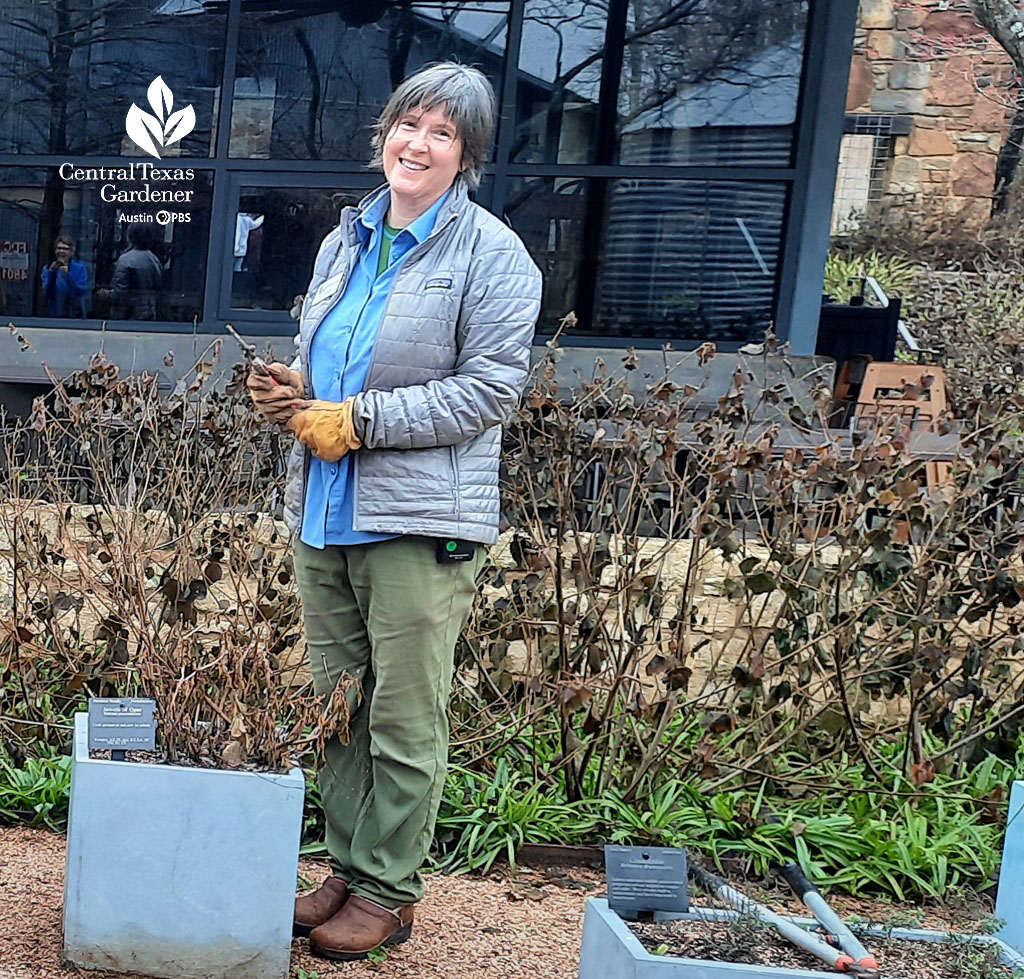
‘Grandma’, like our other “Tenacious” shrub roses, doesn’t need fancy pruning. But since all roses gain a lot more personality with a yearly haircut, Daphne explains why we prune them in February.

spring buds on The Fairy rose

Since roses and many of our plants want good drainage, especially in heavy soils, Merredith Jiles from The Great Outdoors shows what to do. If starting from scratch, definitely check out his explanation of expanded shale, something I rely on now for new succulents and any new plant in my clay.

Improve soil drainage The Great Outdoors

All our plants, whatever we select, are “Healing.” On tour, get ideas to inspire your healing design from the Tranquility Garden at University Medical Center Brackenridge, where TBG landscape architects turned asphalt into gardens of recovery.


Thanks for checking in! See you next week, Linda

Drought disasters to avoid

January 30th, 2013 Posted in Summer plants, Techniques, butterflies, deer, drought, garden design, garden designers, habitat, lawn replace, native plants, shade plants, trees, wildlife | 15 Comments »

Drought doesn’t scare me to pieces. My plants have been through it all and always come back for more. Yes, I do water some, but not outrageously. I avoid thirsty ones and go for those that can take our brutal swings.
Rock rose and turk's cap wildlife plants

What scares the living daylights out of me is overreaction to drought. I keep seeing people make a clean sweep of it all and dumping yards of rocks over former living ground. Aside from being hot, hot, hot, and a mess when “weeds” inevitably find a niche, what about the wildlife we banish?

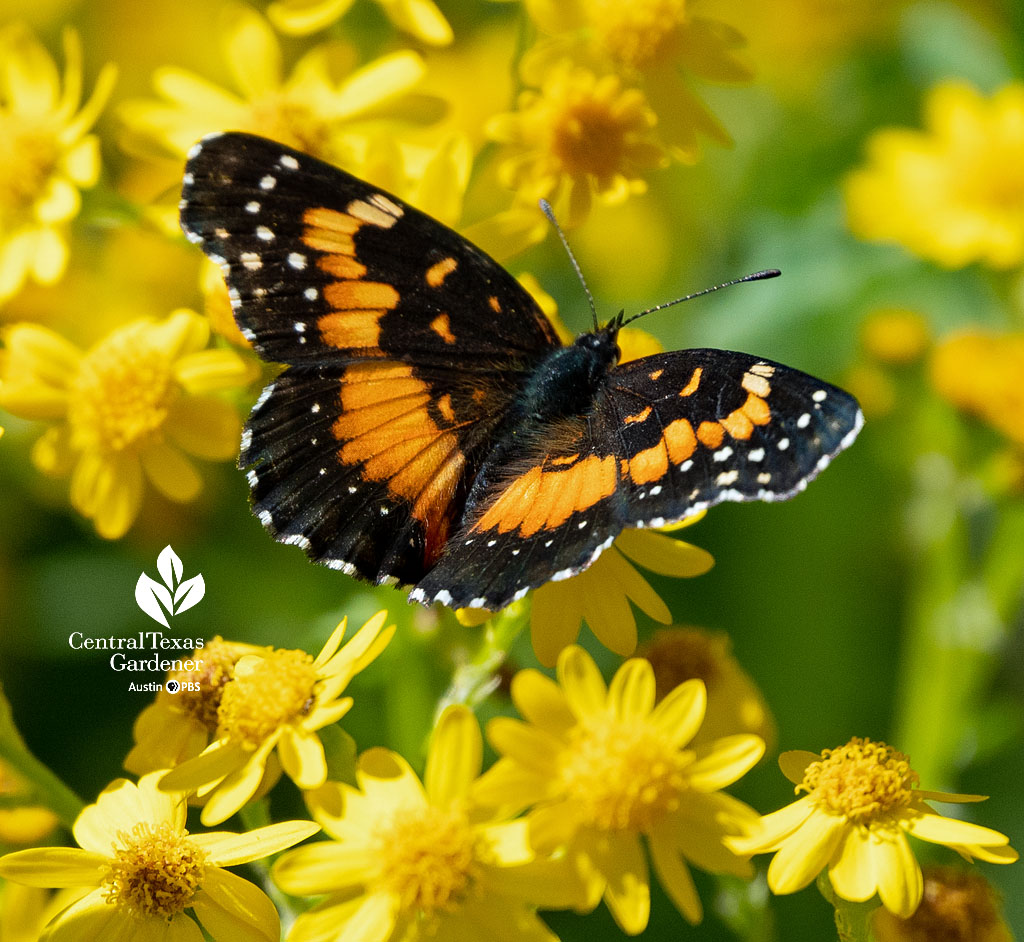
Bordered Patch butterfly on zexmenia

New Mexico landscape architect David Cristiani is very familiar with this frightening response. He made the trip to Austin to join Tom for his insightful perspective to steer us away from ecological disaster. Follow his insightful blog, The Desert Edge, for more of his perceptions.

Tom Spencer and David Cristiani Central Texas Gardener

Some plants thrive in rock, for sure. But a lot do not, like many of our trees and native plants! If we force them into unnatural habitat, what happens? Okay, bet you got that one: death.

Dead tree rockscape photo by David Cristiani

Hot, ugly, and not much life in sight, other than the person who comes to blow debris off the rocks: is that how we want to deal with drought?

Hot rockscape photo by David Cristiani

Nope, says landscape architect Christy Ten Eyck, who lived in Phoenix for many years. Now, she’s in Austin, keeping busy designing across state lines around the country with her important message to keep our wildlife intact. On tour in her Austin garden, see how she connects the drought dots without sacrificing essential content, like our lives!

Christy’s garden includes many clumping grasses. These drought tough plants, like Lindheimer muhly, are superb standouts for texture, structure, and striking seed heads.

Lindheimer muhly and agave

Most of them go dormant in winter. So, when should we prune them and how far down do we cut? Daphne gives us the cutting edge scoop. We want to keep them up as long as possible, since their seed heads, like those of Gulf muhly, are still gorgeous in this mild winter.

Gulf muhly seed heads

I think they look great in their winter rendition! Butterflies agree, since overwintering ones hide in the leaves to stay warm. Some birds go for the seed heads, too.

Silver bluestem

Daphne explains that we do want to cut them back by the end of February to clean up before new growth emerges. With inland sea oats, cut all the way to the ground. I cut some of mine already to show you how their new leaves are already popping up.

inland sea oats new growth

Strappy ones, like Mexican feather grass, get a straight haircut to about 6” above ground.

mexican feather grass seed heads

Mexican feather grass cut back

Get Daphne’s techniques to make the job easier on large plants like Lindheimer muhly. Cut this neighboring Mexican bush sage (Salvia leucantha) down to the rosette.

Lindheimer muhly and salvia leucantha

A chore we can’t delay is wrangling those weeds! With the low rainfall, they’re not as crazy as in wet winters, but even a few mean a lifetime supply if we let them go to seed. See how Merrideth Jiles from The Great Outdoors snags them.

Merrideth Jiles The Great Outdoors

Now is also an excellent time to plant trees before it gets hot in earnest. Take a look at Daphne’s Pick of the Week, Mexican orchid tree, (Bauhinia mexicana), if you’re looking for a small shrub-like tree in dappled light.

Mexican orchid tree Bauhinia mexicana
Like Christy, plant it where you can see the butterflies and hummingbirds that flock to its flowers from summer to early fall. And you’re good to go in deer country, since (usually) they won’t bother it.

Mexican orchid tree flower hummingbird plant

Thanks for stopping by! See you next week, Linda

Why plants freeze|Greg Grant vegetables

January 24th, 2013 Posted in Crinum lilies, Texas A&M, annuals, books, destinations, frost protection, fruit trees, garden structure, native plants, organic fertilizers, perennials | 2 Comments »

My crinums don’t look so hot right now.

Frozen crinum leaves
No problem: I simply cut off their mushy leaves and they’ll rebound pronto. Although things have been rather tame this winter, we’ve had our little cold spells. The top question goes to Daphne this week: Why do plants freeze and what will return?

This annual Salvia coccinea is gone for good, unless it re-seeds in self-appointed locations!

frozen salvia coccinea

Microclimates, plant DNA, maturity, and temperature all make a difference. As we approach the last freeze date, I’ll cut back my Pride of Barbados in readiness for new growth.

Freeze damage Pride of Barbados

Here’s how Daphne explains what happens, per Dr. Jerry Parsons, retired Extension agent: “Fill a glass half-full with water and put it in your freezer. Take it out the next day, once it’s thoroughly frozen, and immediately place it under a warm stream of tap water and watch what happens.”

As Daphne says, I bet you’ve already got it: the glass will shatter. That’s what happens to plant cells as they thaw out when temperatures warm up. Some plants just lose their leaves, like this lantana.

Lantana freeze damage purple leaf

Others lose their lives, like this perennial salvia ‘Anthony Parker’.

Salvia 'Anthony Parker' freeze

But get this: just 8’ away in the same bed, this one was fine!

Salvia 'Anthony Parker'

Since vegetables contain lots of water, a simple cover on freezing nights usually does the trick. Check out my neighbor’s hoops to elevate her row cover. They’re just plain old PVC pipes, easy to bend, but she doctored them up with a bit of spray paint!

cute PVC hoops vegetable row cover

If you’re growing ‘Gold Star’ esperanza—a root-hardy perennial —you can thank horticulturist Greg Grant. His many contributions to our gardens and our libraries, like Heirloom Gardening in the South (with Dr. William C. Welch), have yet another.

Texas Fruit & Vegetable Gardening Greg Grant

This go-to guide, written in Greg’s “here ya go” style, deciphers essentials from soil to planting times, cultivation, and starting and saving seeds. Arugula to winter squash, nuts, berries, and fruit trees: it’s all here, including mouth-watering Grant family recipes.

Greg joins Tom this week for some tried and true tips to get you growing.

Tom Spencer and Greg Grant

He made the trip from Nacogdoches, where he’s a horticulturist at the Pineywoods Native Plant Center at Stephen F. Austin University. Stephen F. Austin University garden greenhouse

And mark your calendars right now for April 20, to nab exclusive SFA and Greg Grant introductions, Texas natives, perennials and more at the renowned SFA Gardens annual Garden Gala at Stephen F. Austin. It’s only from 9 a.m. – 2 p.m, so grab your wagons and get there early! It’s also a wonderful time to see the beautiful gardens.

Weeping cypress Greg Grant Stephen F. Austin University

Visit www.sfagardens.sfasu.edu and click on “garden events” for a list of available plants!

Another new Grant release from Texas Gardener magazine pulls together 10 years of his philosophical, humorous, and botanical insights from the magazine. Now in hardcover, it’s also available as an e-book.

In Greg's Garden

On tour, first-time gardener Ellie Hanlon teaches us a few things, too!

On her blog, Mostly Weeds, follow her step-by-step process from Day 1 to irrigation how-to, including her dual valve system and fertilizer. When she first set up her garden, Austin’s water restrictions required a variance (that she posted on her fence) for vegetables. With a flick of a valve, she could turn off the drip system to her flowers.

irrigation valves fertilizer central texas gardener

To fertilize both vegetables and ornamentals, Trisha demonstrates how to make compost tea, along with a trick using recycled nursery containers to slowly distribute it and organic granulars.

Thanks for stopping by! See you next week, Linda

Mushrooms: Your Garden’s Best Friend

January 17th, 2013 Posted in Agave celsii, books, garden design, garden structure, habitat, lawn replace, mulch, native plants, pruning, shade plants, trees, wildlife, winter color | 2 Comments »

Remember last spring and fall when mushrooms appeared like magic? I always get a few, but last year, many mornings were absolute wonderland!
cute garden mushrooms
Some gardeners fear that mushrooms mean something really evil.

Cute spring garden mushrooms
Actually, it’s just the opposite! Tom meets with Ashley McKenzie from the Texas Wild Mushrooming Group to explain what mushrooms are doing and how lucky you are to have them.

Ashley McKenzie and Tom Spencer

What is a mushroom? Ashley tells us that it’s the fruiting body of an underground network called a mycelial mat. This mat is interspersed among all habitats. If you see a cobweb sort of structure under the soil, that is the mat.

Mushrooms in plant container
The mycorrhizal relationship between plants and fungi, like mushrooms, is very beneficial for plant health, soil fertility and drought tolerance, to name just a few. You can buy mycorrhizae, but if you’ve got mushrooms, it’s free!

Wild brown mushrooms
Ashley describes the habitats where they’ll pop up in our gardens, why they emerge after rain when soil temperatures are cool, and how to collect their spores and encourage more.

Mushroom in salvia greggii
Check out the Texas Wild Mushrooming Meetup group to join them for their educational and fun “flash forays” after a rain to learn what is edible.

Chicken of the Woods Texas Wild Mushrooming Group

Until then, certainly don’t eat anything from your garden—just let them feed your plants!

Orange mushroom Central Texas Gardener

Find out more about mycorrhizae benefits from Texas A&M.

In Austin, South Austin Mushrooms is supplying Oyster and soon, Shitake mushrooms, if you want to grow your own edible ones! For now, they’re only on Facebook, but will have their website up soon.

Pruning’s on our minds, so let’s not forget those trees on our to-do list!

winter tree pruning
Daphne explains why to prune in winter while they’re dormant. “Their plant sap, which contains water, nutrients and hormones, isn’t actively flowing at this time of year. This means that the cut surface won’t have lots of sap rushing to it, as it would in the spring, which would attract insects and disease spores—which are also more active in warmer weather—to the source of a direct route into their body.”

Still, we want some sap flow to naturally heal the cuts. SO, you don’t need to paint cuts on most trees, since that will impede natural healing. But, you MUST paint cuts on red oaks and live oaks immediately to protect them from the beetles that vector oak wilt. You’ll want to get those trees pruned in the next few weeks.

Oak tree prune branch collar
Ah, now about pruning everything else! Relax: there’s no reason to scurry around to tidy up. Top growth can protect roots, grasses hide overwintering butterflies, and seeds feed hungry animals and birds.

Instead, take a winter walk in your garden to simply revel in its beauty.

Evergreen sumac berries

Turn off your editing mode and absorb its graceful shapes and textures and how the light plays upon them.

Agave celsii
Instead of clamping those pruners, ponder the mystery locked into each seed head.

Gulf muhly seed heads
Then, just gush over the intense colors that only come with frost.

Plumbago scandens winter leaf color
We’ll get into pruning next week! For now, take a winter wander through Lynne and Jim Weber’s garden, where wonder never takes a break.

Follow the seasons (including mushrooms and slime mold!) in their very hands-on guide to natural life in Austin.

Nature Watch Austin

We can plant many things, like Daphne’s Pick of the Week, Mountain pea (Orbexilum sp.).

Mountain pea (Orbexilum sp.)

If you want the perfectly behaved plant for sun or even shady spots (like under your oak trees), this one is for you! As a 2’ tall “groundcover,” its tidy leaves and rounded form make a great foil against other textures. In fall, tiny flowers are simply a bonus against its evergreen simplicity.

Mountain pea flower
I first met it years ago when Pat McNeal introduced it on CTG as a lawn replacement. Then, it was harder to find, but thanks to growers who recognize a good thing, look for it at your local nursery. I nabbed one (and more to come) from Michelle Pfluger at Green ‘n Growing. Here’s her CTG list for other great groundcovers.

Plus, while it’s still cool, we can get after those projects on our lists—like structures to wrangle vining plants and upcoming tomatoes. Trisha shows you how.


Thanks for stopping in! See you next week, Linda